


















The most useful rule for bedside tables is to start with the top of your mattress: choose a surface you can reach comfortably while lying down or sitting up. Then check the table’s width, depth, storage, and position against the space beside your bed.
In this guide, we use “bedside table” and “nightstand” interchangeably. There is no requirement to buy a matching pair. The measurements below are starting points for shopping, not building standards. A quick reach test with your actual bed matters more than getting every number exactly right.

Table of Contents
Bedside Table Rules at a Glance
| What to check | Starting point | Confirm in your bedroom |
|---|---|---|
| Height | Near mattress level; try within 2 in. (5 cm) | Reach while lying down and sitting up |
| Width | Common range: 21–28 in. (53–71 cm) | Frame, headboard, and available side space |
| Depth | Common range: 16–20 in. (41–51 cm) | Surface needs and getting out of bed |
| Bedside gap | Trial gap: 3–6 in. (8–15 cm) | Bedding, reach, and drawer clearance |
| Number and style | One or two; matching is optional | Each person’s routine and room layout |
Height guidance comes from Costco’s bedroom furniture guide; common sizes and the trial gap come from Wayfair’s nightstand size guide. These retail recommendations describe useful starting points, not universal rules.
Rule 1: Match the Height to Your Mattress, Not Just Your Bed Frame
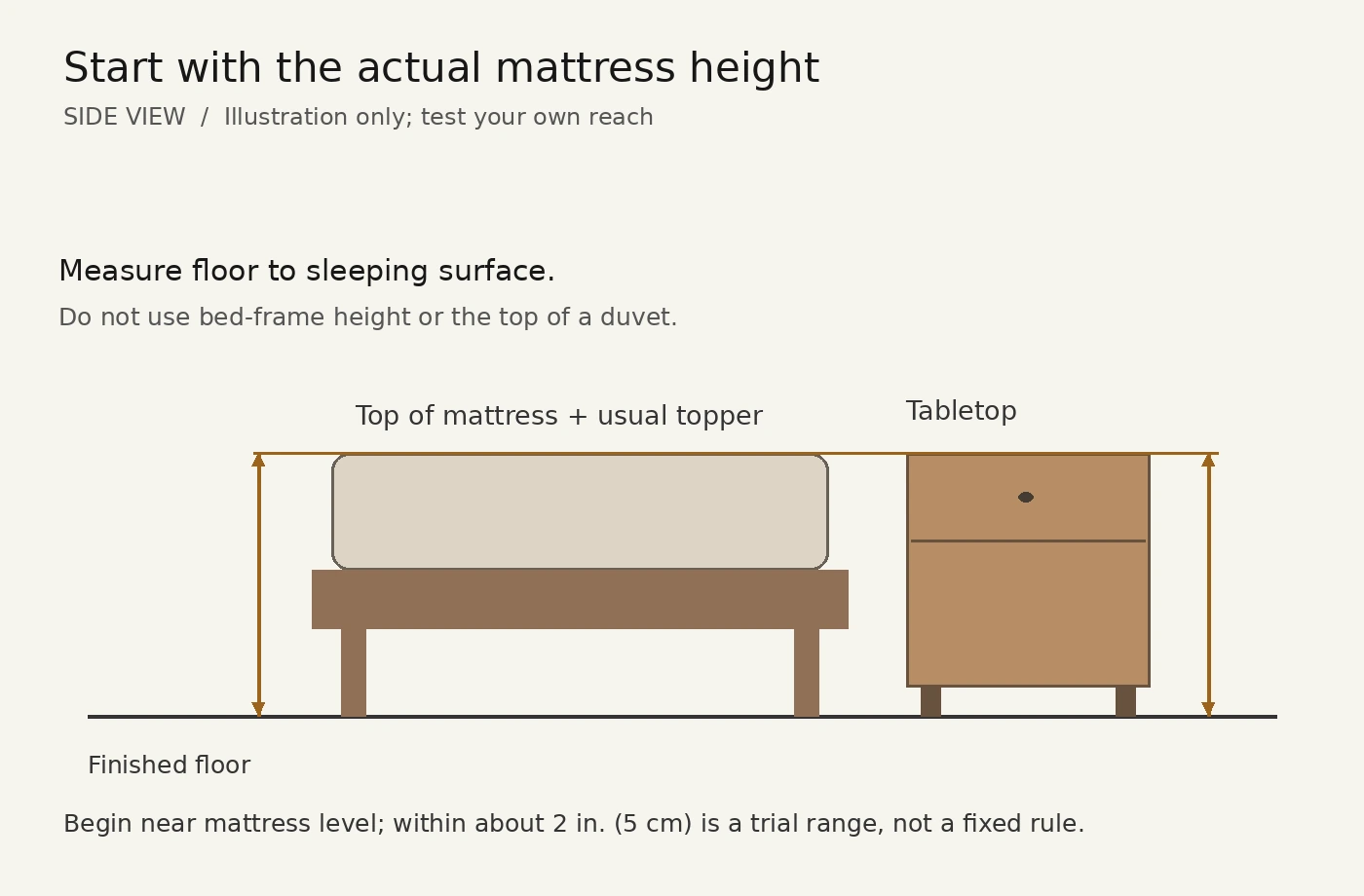
Measure from the finished floor to the top of the mattress you sleep on, including your usual topper. Use the final bed frame and mattress combination. A frame’s listed height does not tell you where your sleeping surface will finish, and a duvet or decorative pillow should not set the measurement.
We suggest beginning your search near mattress level. Costco recommends a nightstand level with the mattress or within about 2 inches of its top. For example, if your sleeping surface is 26 inches (66 cm) above the floor, you could first compare tables around 24–28 inches (61–71 cm). That is a shopping example, not a guarantee of comfort.
Before ordering, mock up the height with a stable surface. Lie in your usual sleeping position and reach for your phone or water glass. Then sit up and try the lamp switch. You should not need an awkward stretch, a deep bend, or a reach over a sharp corner. Check both sides if two people use the bed.
A low platform bed may need a shorter table; a thick mattress or topper may call for a taller one. For an adjustable bed, test the positions you actually use. When choosing from our bedroom furniture options, compare finished dimensions as a complete setup rather than selecting the bed and nightstands independently.
Rule 2: Choose Width and Depth Around the Space You Actually Have
Measure the bed’s outer frame, including any projecting rails or headboard wings. Then measure the usable space on each side, allowing for curtains, closet doors, and other furniture. A king bed may look balanced with wider nightstands, but the room must still accommodate them comfortably.
Wayfair lists 21–28 inches as a common width and 16–20 inches as a common depth. Smaller and larger options can work. Treat these ranges as a way to understand product scale, then let your room and daily essentials determine the shortlist.
Mark each candidate’s footprint with painter’s tape, or place a cardboard rectangle on the floor. Add the handle projection and open the nearby doors. Check how far the drawers extend, where plugs will sit, and whether you can get out of bed naturally.
Depth is easy to overlook in a product photo. A deep cabinet can bring its front corner into your route, while a shallow table may leave too little space for a lamp and water. Compare the complete footprint, not just the attractive front elevation.

Rule 3: Leave a Practical Gap Between the Bed and Nightstand
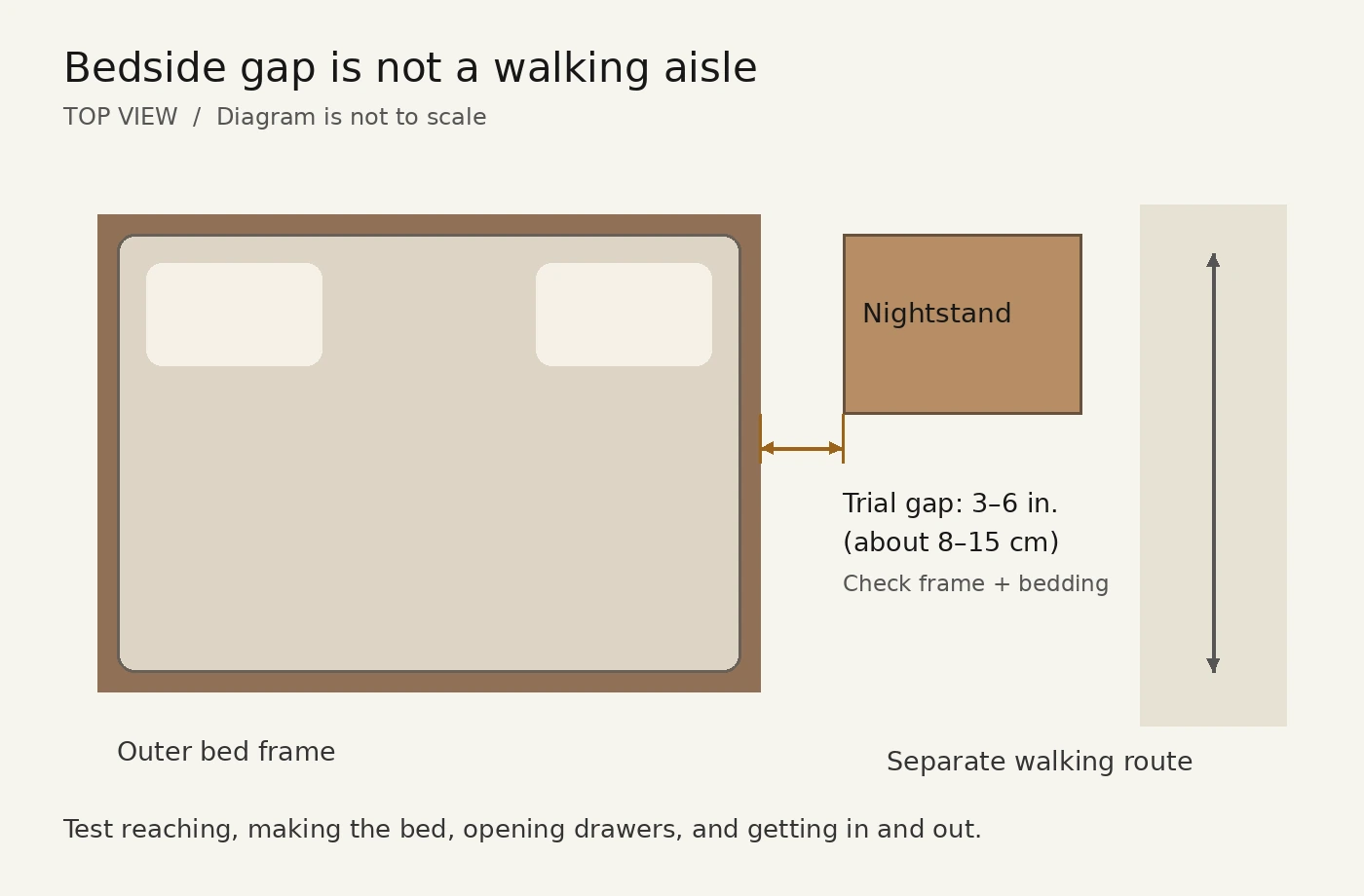
Try a gap of roughly 3–6 inches between the table and the bed as an initial placement, following Wayfair’s guidance. Measure from the outer bed frame, then check how your bedding falls into that space. Measuring only from the mattress can miss a projecting frame or a thick duvet.
If the table is too close, making the bed becomes awkward and bedding can catch in drawers. Too far away, and everyday items may be difficult to reach. Also check the wall behind the cabinet: baseboards, curtains, and plugs may prevent it from sitting where you expected.
Use a simple sequence: make the bed, open every drawer, get in and out, and reach for the items you use at night. Move the table and repeat until the position works.
The small gap beside the mattress is not a walking aisle. Keep a separate, usable route through the bedroom; its requirements depend on the layout and the people using it. Do not apply the 3–6-inch suggestion to circulation space.
Rule 4: Coordinate Your Nightstands Without Forcing an Exact Match
A matching pair gives the bedroom a calm, symmetrical starting point. It is also convenient when both people want similar storage. But two different tables can feel equally considered when they share a wood tone, color, shape, or similar visual weight.
Start with function on each side. One person might need drawers for glasses and chargers; the other may prefer an open shelf for books. The widths and internal layouts can differ, provided each surface remains comfortable to reach and neither piece crowds the room.
Then look at the whole wall. Repeat an accent color or choose lamps that relate to one another without making everything identical. Wall sconces can help balance the lighting composition, but they cannot make a badly positioned tabletop comfortable.
Your bed, dresser, and nightstands do not need to come from one collection. A few shared details usually provide enough connection. Make the choices around each person’s habits and taste, rather than assigning furniture styles by gender.

Rule 5: Plan the Surface and Storage Around Your Nightly Routine
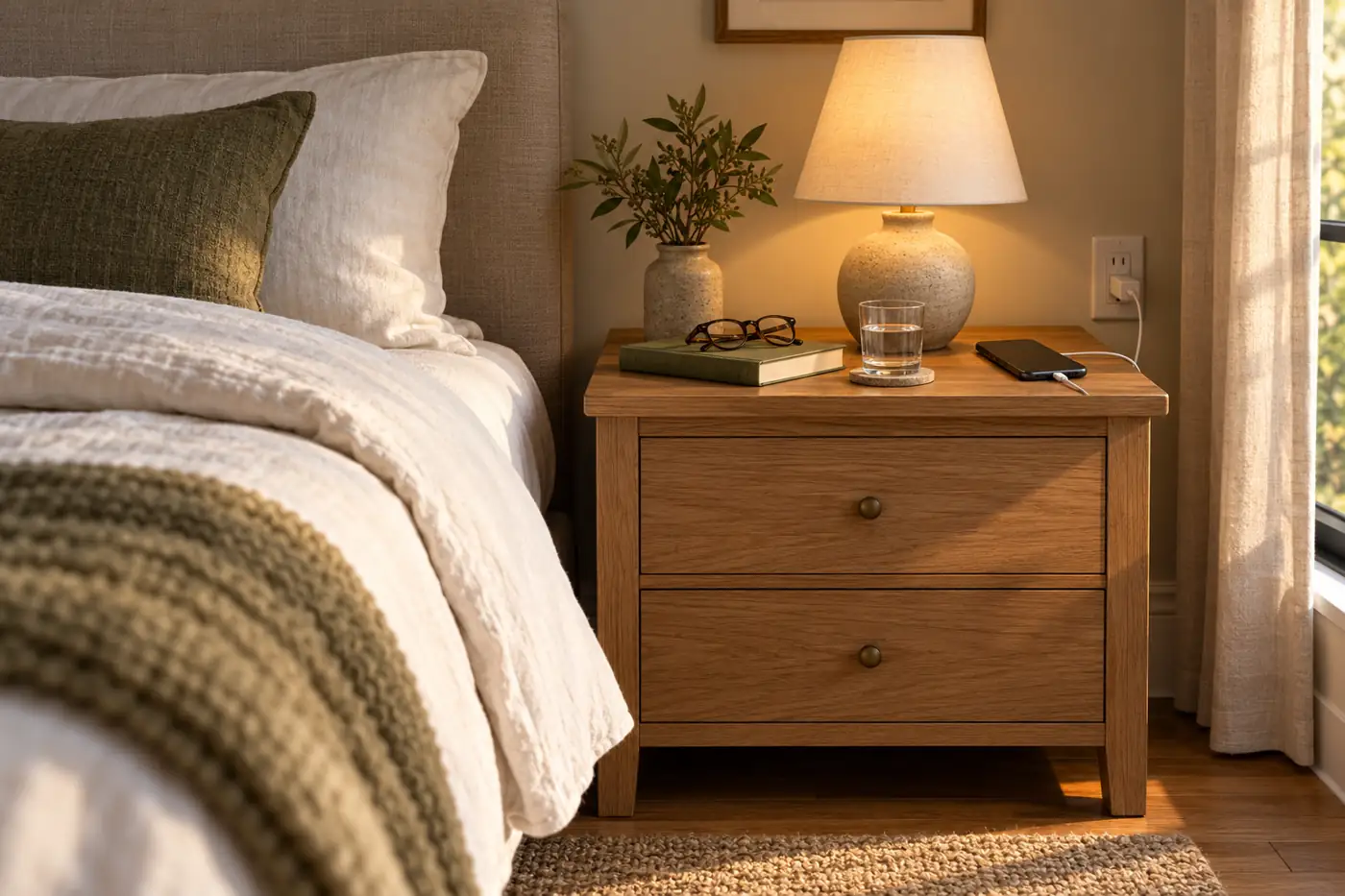
Write down what actually lives beside your bed: phone, glasses, water, a book or e-reader, remote controls, and charging accessories. Lay those items out before choosing a table. Keep frequently used objects within easy reach and leave a clear spot to set something down in the dark.
A drawer helps contain small items; an open shelf makes books visible and accessible. Decorative objects should fit around your essentials. If you use a device beside the bed, check its dimensions, ventilation and cable requirements against the manufacturer’s instructions.
Look beyond the finish: test stability, drawer movement, handles, and how easily the surface can be cleaned. No material name alone guarantees longevity. For an integrated bedroom scheme, custom cabinetry can align storage with the space and your routine.
Rule 6: Coordinate Lamps, Outlets, and Charging Before You Buy
Choose the table and lamp together. Mattress height, tabletop height, and your reading posture all affect how the light feels. Check the lamp base and shade footprint so they leave usable surface space, and test whether you can reach the switch without moving everything else.
For a small tabletop, a wall-mounted reading light may free up space. Confirm its position from the bed before installation, including glare, reach, and any adjustment mechanism. Coordinate installation with an appropriate professional rather than assuming one mounting height suits every room.
List the devices you charge and check where their cables will run. Built-in charging can be convenient, but verify compatibility, local electrical requirements, and whether charging components can be replaced. Keep access to outlets practical; a cabinet that blocks the socket may make a simple charger change frustrating.
Explore our lighting options alongside the furniture plan so the lamp, switch, outlet, and tabletop work together from the start.
Rule 7: Adapt the Rules for Small Bedrooms and Floating Nightstands
In a compact bedroom, try a narrower cabinet, a shallower drawer unit, or a simple bedside shelf. A floating nightstand exposes more floor and can make cleaning easier, but it still occupies horizontal space. Check its projection and drawer opening just as you would with a freestanding piece.
Confirm the wall construction, suitable fixings, and the unit’s stated load limit before installation. A wall-mounted design needs proper support; its appearance does not tell you what it can hold.
If two people share the bed, aim to give each person a useful surface and accessible light. The two sides can differ. Keep doors and movement routes clear rather than squeezing in a matching pair purely for symmetry.

FAQs About Bedside Tables
Should a bedside table be higher or lower than the mattress?
Start near the mattress top, then test your reach. A slightly higher or lower surface may suit your posture, but a large difference can feel awkward. Measure the actual sleeping surface and try the table while both lying down and sitting up.
Do you need two bedside tables?
No. One can work for a single sleeper or a bed positioned against a wall. When two people share a bed, a useful surface on each side is often convenient. A small shelf may work where a full cabinet cannot fit.
Can bedside tables have different widths or styles?
Yes. Keep each table practical for its user and connect them through a shared color, material, or visual detail. Different storage needs can justify different widths. Check the balance of the whole bed wall rather than matching every feature.
Should you buy the bed or the nightstands first?
Confirm the bed frame, mattress, and topper dimensions first, or select the complete group together. Otherwise, the finished mattress height may surprise you. Recheck the room’s side space before ordering, especially if you change bed size or headboard style.
Plan a Bedroom That Works for You
Before ordering, recheck mattress height, the outer bed frame, available side space, drawer opening, lighting, and outlets. Share your bedroom plan, bed dimensions, and preferred style with George. We can help coordinate bedside furniture, cabinetry, and lighting around a room that works for your daily routine.